Dry Bulk Vessels, Tankers and Supporting Ships
In 2025
Assisted with Strait Transit Agency Service
Heisenberg Shipping offers transit strait agency services through the Bosphorus and Dardanelles straits in Turkey. Heisenberg Shipping also provides a range of services for vessels during the Turkish Straits transit passage. Our team makes sure that your vessel passes through in both directions of Bosphorus and Dardanelles smoothly. As a strait agency in Bosphorus(Istanbul Strait) and Dardanelles(Canakkale Strait), we provide professional transit assistance to your dry bulk vessel at competitive rates.
Transit Strait Agency Service of Heisenberg Shipping: The easiest link between Mediterranean and Black Sea
Heisenberg Shipping’s Transit Strait Agency service is impressing shipowners and ship operators. We assist ships passing through the Bosporus and Dardanelles with our Turkish Straits Transit Agency service. We also provide our Transit Strait Agency service to the towage operations passing via Canakkale (Dardanelles) and Istanbul (Bosphorus) Straits.
The Turkish Straits play a key role in trade to and from the Black Sea because they are the only way to access Black Sea ports. It is important to manage time and costs when ships pass through the busy Bosporus and Dardanelles straits.
Heisenberg Shipping is the best choice for shipowners and ship operators looking for a Transit Strait Agency in Bosphorus and Dardanelles. We ensure safe passage for vessels through these important transit routes.
Heisenberg Shipping offers a smooth and safe passage to the vessels passing through the Turkish Straits in both directions (Northbound & Southbound). Our own ship agency personnel in the Istanbul office take all necessary actions and ensure your vessel passes through the Turkish Straits safely and quickly with minimum waiting time.
Talk to Us
Head Office / Turkish Straits (Bosphorus and Dardanelles)
*Contact us regarding PDAs, operation-related matters, urgent actions, and port information purposes.
During the passage of your vessel at the Turkish Straits, we also arrange supply and crew assistance services at the most optimum conditions. Our services at Turkish Straits include but not limited to the following,
Assisted with Strait Transit Agency Service
Up To 300M LOA, We Are at Your Service in Bosphorus Transit Passages
As Heisenberg Shipping, we provide full Transit Strait Agency service to our customers at Bosphorus Strait. Since our main segment is dry bulk vessels, our transit passage agency service covers dry bulk vessels up to 300M LOA.
Bosphorus Strait is located in the city of Istanbul which is the largest city of Turkey. Due to its geographical location, Bosphorus Strait is the only way to reach Black Sea from East Mediterranean or from East Mediterranean to Black Sea. This makes the Strait very busy and waiting times can go up to a week.
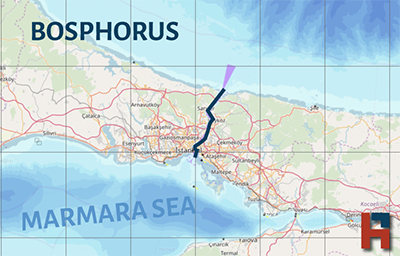
Heisenberg Shipping, thanks to its close relations with local authorities, makes sure that you vessel’s waiting time to be kept at minimum.
Up To 300M LOA, We Are at Your Service in Dardanelles Transit Passages
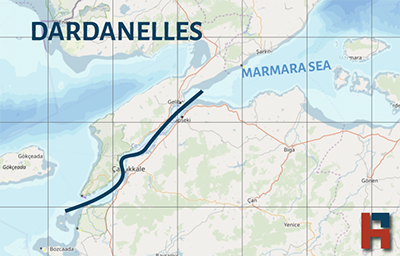
Dardanelles Strait is the South entrance of the Marmara Sea. This is the point where the Mediterranean Sea links to the Black Sea via Marmara. Dardanelles Strait is in Çanakkale city. As Heisenberg Shipping, we provide full transit passage agency service for dry bulk vessels entering or leaving the Black Sea via Dardanelles Strait.
The same LOA regulation of Heisenberg Shipping also applies here. We safely assist the smooth passage of dry bulk vessels up to 300M LOA at Dardanelles.
For Dardanelles passage, shipowners mostly prefer the Ships Supply or Crew Change operations to be handled in Bosphorus since it is an easy access point for them. In some cases where Bosphorus waiting times are less, we suggest our customers use Dardanelles for such Husbandry Services.
*Dardanelles Strait Entrance Coordinates,
South In / North Out: 40°01’19.1″N 26°10’17.0″E / 40°25’39.7″N 26°45’33.5″E
North In / South Out: 40°25’39.7″N 26°45’33.5″E / 40°01’19.1″N 26°10’17.0″E
**Bosphorus Strait Entrance Coordinates,
South In / North Out: 40°57’33.3″N 28°57’35.1″E / 41°13’56.7″N 29°08’07.0″E
North In / South Out: 41°13’56.7″N 29°08’07.0″E / 40°57’33.3″N 28°57’35.1″E
In summary, Heisenberg Shipping’s Transit Strait Agency is your dependable partner for efficient and trustworthy passage through the Bosphorus and Dardanelles straits. The Turkish Straits are key passageways for ships traveling between Aegean and Black Sea. They are open to all commercial ships as long as the requirements of the Turkish Government and respected authorities are met. The passages through Turkish Straits are controlled by VTS (Vessel Traffic System) in Turkey.
Committed to customer satisfaction, our agency offers a comprehensive suite of services and additional solutions to guarantee a seamless and trouble-free transit experience. From swift spare parts delivery to expert guidance, we prioritize your requirements and continually strive to deliver exceptional service.
Navigating the intricate Turkish straits can be challenging, but with Heisenberg Shipping’s extensive expertise and unwavering support, you can rest assured that your transit will be managed with the utmost professionalism. Whether you need passage through the Bosphorus or Dardanelles, our agency is fully equipped to cater to your needs and ensure a smooth voyage.
Opt for Heisenberg Shipping’s Transit Strait Agency to enjoy a reliable and efficient passage through the Turkish straits. Contact us today to discover more about our services and how we can be of assistance to you.
Realtime Weather Map of Istanbul and Canakkale
Explore the interactive map, specifically designed to monitor wind conditions at the crucial maritime gateways of the Istanbul Strait and Canakkale Strait. This powerful tool is an indispensable resource for mariners, providing a detailed and real-time glimpse into the ever-changing wind patterns that significantly influence navigation through these strategic waterways.
The Authority for Maritime Safety and Navigation at Turkish Straits
The Head of Vessel Traffic and Pilotage Services is an important part of Turkey’s General Directorate of Coastal Safety. This department is in charge of managing the Turkish Straits Vessel Traffic Services (TSVTS). It also provides Pilotage Services in Turkish waters.
The main goal of the TSVTS is to improve maritime safety. It also aims to protect the marine environment and manage vessel traffic in the Turkish Straits. This vital waterway includes the Istanbul Strait (Bosphorus), the Sea of Marmara, and the Çanakkale (Dardanelles) Strait.
Stretching over 164 nautical miles, the Turkish Straits connect the Black Sea to the Aegean Sea. The area has many challenges. There is heavy traffic, narrow channels, strong currents, and sharp turns. Ships carrying dangerous cargo are also present.
Key Responsibilities and Services:
The TSVTS is recognized as one of the largest and most advanced VTS systems globally. The department plays a crucial role in international maritime safety, actively participating in bodies like the IALA VTS Committee. Its efforts have significantly improved navigational safety and traffic efficiency in one of the world’s most critical waterways.
Annual Vessel Passage Trends in the Bosphorus and Dardanelles – Operational Density Analysis for Shipowners (2026)
The Turkish Straits, the Istanbul Strait (Bosphorus), and the Çanakkale Strait (Dardanelles), connects the Black Sea to the Mediterranean via the Sea of Marmara. These straits are naturally formed straits with tight passage ways for the ships. These straits serve as a primary transit route for bulk carriers, tankers, LNG vessels, container ships, and general cargo vessels operating between Europe, Asia, and the Black Sea region.
Understanding statistics of the transit patterns is essential for shipowners, charterers, and operators. Vessel traffic volume directly influences voyage planning, risk exposure, waiting time calculations, traffic congestion forecasting, pilotage planning, and chartering strategy. Historical data provides operational insight into how the system behaves under varying global economic conditions.
Below is a long-term overview of annual vessel passages through both straits between 2006 and 2025 for Istanbul Strait and Canakkale Strait.
The Bosphorus recorded its highest transit volume in 2007 with 56,606 vessels, following 54,880 vessels in 2006. After this peak, a structural decline began. Traffic fell to 54,396 in 2008 and 51,422 in 2009, continuing downward through the next decade. By 2014, annual passages had decreased to 45,529, and by 2019 they stabilized around 41,000 vessels.
Pandemic-related slowdowns pushed figures lower between 2020 and 2022, reaching 35,146 vessels in 2022. Recovery began in 2023 with 39,000 transits, increasing to 41,363 in 2024 and slightly moderating to 40,172 in 2025.
Despite the long-term decline from the 2007 peak, the Bosphorus consistently handles 35,000–40,000 vessels annually, maintaining its status as one of the busiest natural waterways globally.
Traffic peaked in 2007 with 49,913 vessels, following 48,915 in 2006. Unlike the Bosphorus, the Dardanelles experienced a more moderate and stable adjustment over time. Between 2010 and 2019, annual passages generally fluctuated between 43,000 and 46,000 vessels.
During the pandemic period, volumes declined to 42,036 in 2020 and 42,340 in 2022. A strong rebound followed, with 44,892 vessels in 2023 and 45,849 in 2024, before easing slightly to 44,468 in 2025.
Overall, the Dardanelles has demonstrated greater stability than the Bosphorus, consistently managing between 42,000 and 46,000 vessels per year over the past two decades.
When the Istanbul and Çanakkale Straits are evaluated together, annual vessel movements have historically ranged between approximately 80,000 and 100,000 transits, confirming the Turkish Straits as one of the busiest natural straits in the world. This sustained traffic density requires continuous sequencing and coordination, particularly for deep draft vessels, LNG carriers, tankers, and large bulk carriers navigating under structured Traffic Separation Scheme rules.
The User’s Guide of Turkish Straits Vessel Traffic Service (TSVTS), issued by the Republic of Turkey’s Ministry of Transport and Infrastructure, provides detailed procedures, services, and regulations for vessels navigating the Turkish Straits. It includes guidelines on communication, reporting systems, sector limits, anchorage areas, and emergency protocols to ensure the safety of navigation, protection of life, property, and the environment.
Download User’s Guide of Turkish Straits Vessel Traffic Service (TSVTS)
We introduce updated VLSFO and LSMGO usage guidelines for port and transit operations, aimed at environmental protection and global compliance, reinforcing our commitment to safe, compliant, and responsible maritime services.
Port Operations:
Arrival at Port Limit Area: Vessels must switch to Very Low Sulfur Fuel Oil (VLSFO) with a sulfur content not exceeding 0.5%.
Within 1 Hour of Anchoring: Ships are required to transition to Low Sulfur Gas Oil (LSMGO) with a sulfur content of 0.1% immediately after anchoring.
During Anchorage: The use of LSMGOwith a sulfur content of 0.1% is mandatory.
Loading/Discharging at Berth or Pier: Vessels must use LSMGOwith a sulfur content of 0.1%.
Departure from Berth or Pier: Ships are to switch back to VLSFO with a maximum sulfur content of 0.5%.
En Route to Next Strait or During Waiting/Passage: VLSFO with a sulfur content up to 0.5% is to be used.
Transit through the Turkish Straits:
Effective from 1st January 2020: For transit passages through the Turkish Straits, vessels must use either VLSFO or LSMGO.
Bunker Adjustment while Waiting at Entrances: Vessels are required to adjust their bunker to utilize VLSFO with a 5% sulfur content when waiting at either entrance of the straits.
During Passage: VLSFO with a sulfur content of 0.5% must be used for the duration of the passage through the Turkish Straits.
Environmental Compliance:
Scrubber Water Discharge Regulation: As of 6th April 2021, the discharge of scrubber water within Turkish Territorial Waters, including all ports and the Turkish Straits, has been prohibited to safeguard marine and coastal environments.
The Government of Turkey issued a notice dated 16 November 2022 which requires all ships transiting or entering Turkish waters from 01 December 2022 (extended to 02 December 2022), to provide letters of confirmation from the owner’s P&I Club attesting that cover will remain in place under any circumstances throughout the duration of the transit or the time the ship is in Turkish waters or the time it is in a port or terminal.
Regarding P&I confirmation letter request by Turkish authorities from vessels carrying Annex I cargo, the Ministry of Transportation has issued a new update on 24 October 2023. According to this, vessels transiting Turkish straits are requested to submit sailing plan-1 (SP-1). Vessels which loaded Annex I cargo from a Turkish port and discharge at another Turkish port are excluded from P&I confirmation letter request while transiting the Turkish Straits. They should instead submit justifier documents (such as B/L, cargo manifest etc) along with SP-1 report to the Turkish authorities.
The Republic of Turkey’s Ministry of Transport and Infrastructure, Directorate General of Maritime Affairs, has issued a revised Turkish Straits Vessel Traffic Regulation Implementation Directive, approved under Ministerial Decree No. 306827 dated 1 October 2025 and entered into force on 13 October 2025. This revision replaces the previous directive enacted under Decree No. 13855 in 2018 and modernizes the regulatory framework governing vessel traffic across the Istanbul Strait, Çanakkale Strait, and the Sea of Marmara. Key changes include: container vessels of 300 m and over may now transit the Çanakkale Strait at night; passenger and container vessels of 300 m and over must notify TBGTH of ETA changes at least 6 hours in advance; the permitted tow length for Turkish-flagged tugs engaged in construction/subsea operations has increased from 90 m to 120 m; LPG vessels between 150–200 m (in ballast or carrying ammonia) are now permitted night transit under pilot and tug escort; transit checklists are now published in both Turkish and English; and Article 15 has been updated with new pilotage and tug escort planning provisions for Çanakkale.
If You Are Looking for Transit Strait Agency Service in Turkey's Bosphorus or Dardanelles
Click to Send

All Rights Reserved, Ags Gemi Acentelik Hizm. Ve Tic. Ltd. Sti (Heisenberg Shipping), 2026